Research Seminar
Deep learning architecture for spectral and chemometric data
Subject Field: Chemometrics and deep learning
Date & Time
(Thursday) 11 Nov 2026 | 03:30 pm
Venue
CR # 403, Old Building, SNS
Speaker Profile
Ms. Sughra Sarwar
PhD Scholar (Mathematics Dept.), SNS
Affiliation: School of Natural Sciences (SNS), NUST
Email: [email protected]
Abstract
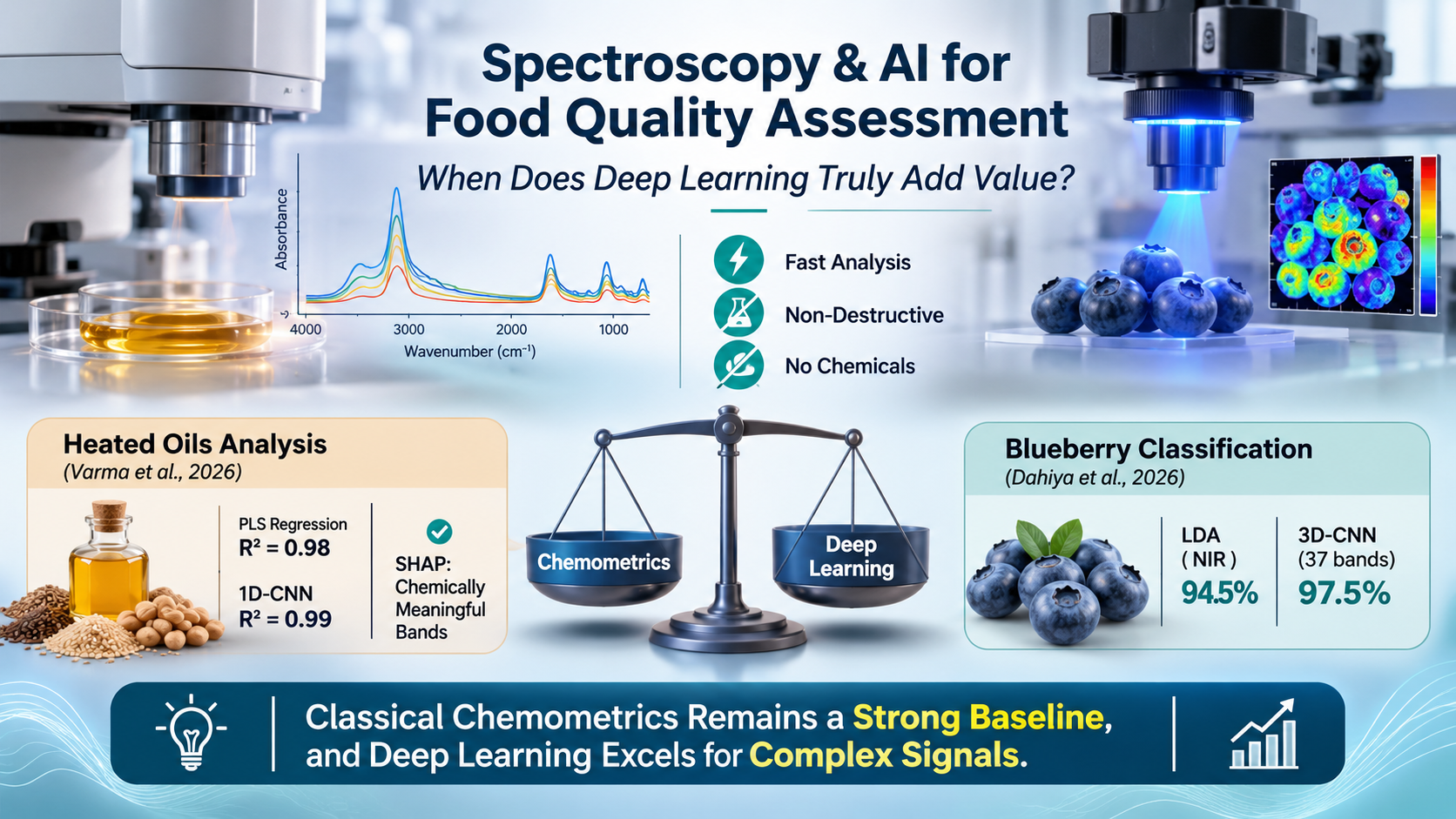
Traditional laboratory tests of food quality are accurate but slow, use chemicals and often destroy the sample. Spectroscopy combined with statistical models offers a fast, non-destructive alternative. This seminar reviews two recent studies that compare classical chemometric methods with deep learning and ask when deep learning truly adds value. The first study (Varma et al., 2026) predicted the acid value and dielectric constant of heated ground nut and sesame oils from FTIR spectra. Trained on 24 laboratory oils and tested on 8 restaurant oils, PLS regression achieved a test R² of 0.98, while a one-dimensional convolutional neural network (1D-CNN) reached 0.99. SHAP analysis confirmed that the network relied on chemically meaningful spectral bands. The second study (Dahiya et al., 2026) classified four blueberry varieties from hyperspectral images of 2,448 berries. Linear discriminant analysis performed best on near-infrared data (94.5%), whereas a 3D-CNN using only 37 selected wavelengths reached 97.5% accuracy. From a statistical perspective, both studies are promising, but their evidence is limited by small or clustered test sets, a single source or harvest, and missing uncertainty estimates. The seminar concludes that classical chemometrics remains a strong baseline, and that deep learning is most useful for complex signals when validated independently.